
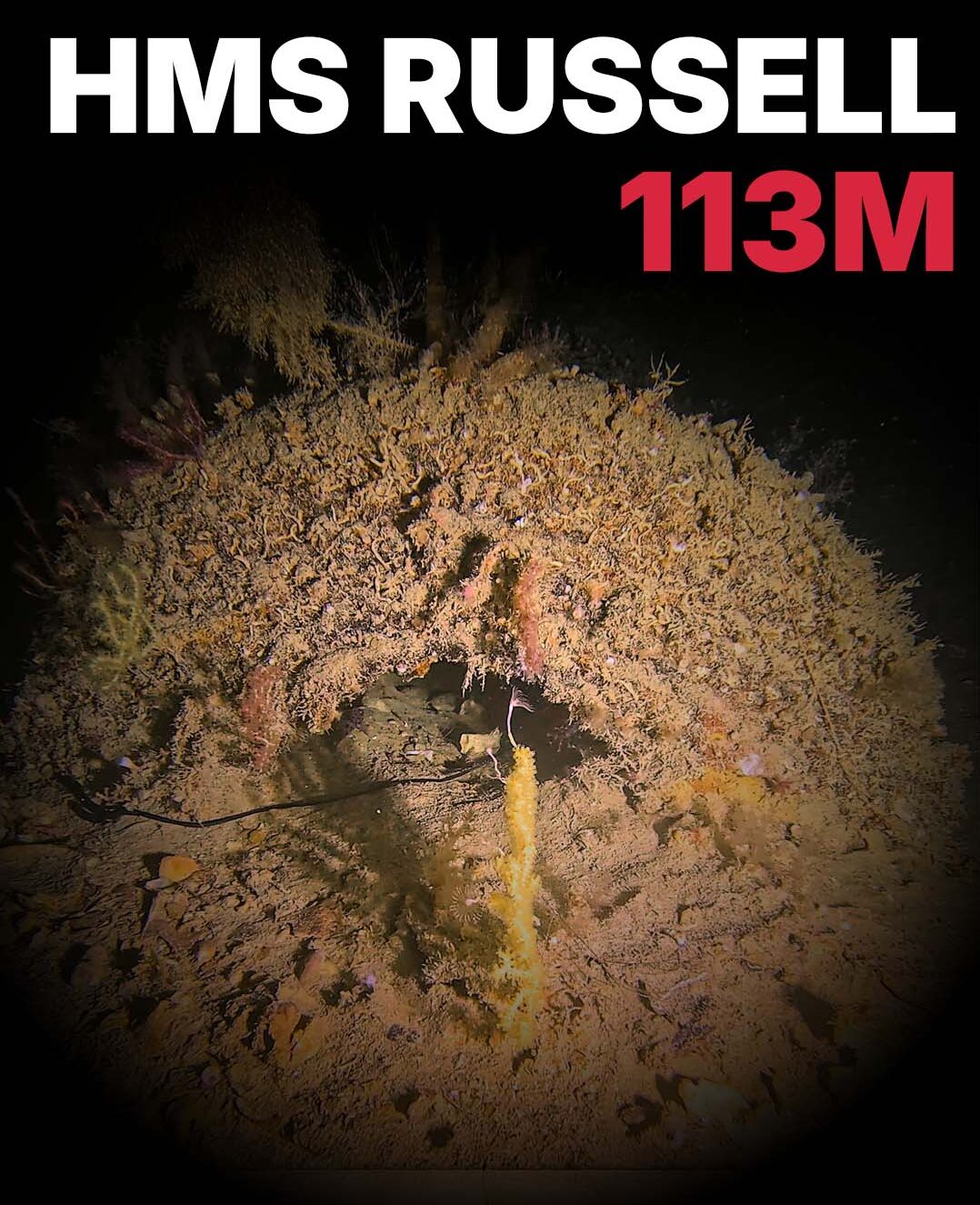
Overview of the Dive Site
HMS Russell is a First World War pre-dreadnought battleship lying upside down on the sand at around 110–115 metres depth, roughly 6 km east of Fort St Elmo / Valletta, Malta. maltadives.com This is an expedition-level deep wreck, suitable only for highly experienced trimix and CCR divers with excellent team skills and discipline.
The wreck is huge (about 130–140 m long) and remarkably intact apart from the stern, which was blown off by the mine explosion. Wikipedia The surrounding seabed is littered with shells and gun cases, and some of the ship’s guns now sit upright in the sand, making this a powerful, atmospheric dive. maltadives.com
Key Facts at a Glance
- Type: Deep WWI battleship wreck, war grave
- Location: Offshore east of Valletta / Fort St Elmo, Malta maltadives.com
- Depth: Approx. 110–115 m to the seabed; top of hull a few metres shallower maltadives.com
- Access: Boat only, offshore site
- Certification: Advanced trimix (OC) or equivalent high-level CCR certification
- Gas: Hypoxic trimix, multiple deco gases; ideal for CCR (Hollis Prism2)
- Permits: Special Heritage Malta permit required to dive (war grave) DiveBoat.mt
- Best for: Experienced technical divers, deep wreck enthusiasts, CCR teams
Location & Access
HMS Russell lies in open sea, about 4–6 nautical miles off Valletta / Fort St Elmo, on a flat sandy seabed. Dive on Malta
- Access is by boat only, usually from Valletta or Marsamxett harbours.
- A shot line is essential for safe descent/ascent and for holding decompression stops in any surface chop.
- Because it’s a managed heritage wreck and a war grave, diving is only allowed with the correct permits and through authorised operators. Heritage Malta
Depth Range & Profile
- Seabed / guns: 112–115 m
- Upside-down hull: around 108–112 m along most of the wreck
- No real “shallow” section – you are in full-on deep trimix territory from the moment you leave the shot line. maltadives.com
Expect a vertical technical profile: a long descent, a short, carefully planned bottom phase, and then a long ascent with extended deep and mid-water deco.
Recommended Certification Level
HMS Russell is not an entry-level technical dive. It’s for divers who already have serious time at 70–90 m and are comfortable with complex gas, bailout and team management.
Recommended minimums:
- Open circuit:
- Full trimix certification (e.g. PADI Tec Trimix or equivalent)
- Substantial experience on 90 m+ dives in similar conditions
- CCR / Hollis Prism2:
- Advanced / full trimix CCR certification with experience in the 90–100+ m range
- Excellent bailout planning and real-world bailout drills completed recently
This is a dive where you should already be very comfortable with task loading, multiple deco gases, team procedures and problem solving at depth before ever stepping on the boat.
Best Season & Typical Conditions
- Season: Late spring to autumn is usual, when sea state and daylight are most favourable.
- Temperature:
- Summer: ~15–18°C at depth (thermoclines common)
- Winter: 13–15°C throughout the water column
- Visibility: Often 20–30 m, but can drop with plankton or weather. Divers Guide
- Sea state: This is open sea; wind and swell can build quickly. Skippers will be conservative.
Why Dive HMS Russell?
What Makes This Site Special for Tec / CCR Divers
- Scale & history: A full-size British battleship, sunk in 1916 after striking mines laid by German submarine U-73 while approaching Malta. Heritage Malta
- Pristine deep environment: Opened to civilian diving only in 2019; still relatively few teams have visited compared to shallower wrecks. maltadives.com
- Serious depth: A true proving ground for advanced trimix and CCR skills – more expedition than “fun dive”.
- Atmosphere: As an official war grave, the dive has a solemn, respectful feel that most divers never forget. Heritage Malta
For capable teams, HMS Russell is one of Malta’s “bucket list” deep wrecks alongside HMS Olympus, HMS Southwold and the deep destroyers. DIVE Magazine
Dive Profile & Route Options
Typical Open Circuit Profiles
On OC, gas volume is the main limiter. Expect:
- Helium-rich, hypoxic back gas (e.g. 8–12% O₂ range depending on plan)
- At least two, often three deco gases
- Bottom times typically 15–20 minutes for realistic gas and runtime control
Most teams:
- Drop the shot to the upturned hull amidships
- Run a short, pre-agreed route along one side of the hull, checking key features and the surrounding seabed for guns and debris
- Start ascent on schedule – overrunning the plan is not an option at this depth
Typical CCR / Hollis Prism2 Profiles
On the Hollis Prism2, HMS Russell becomes more logistically manageable, though still extremely serious:
- Longer possible bottom times (e.g. 20–30 minutes) for similar or slightly extended runtime compared to OC
- Better gas logistics and reduced helium cost
- Bailout plan drives everything – you plan as if you might have to complete the entire ascent on OC
A common approach:
- Descend on a fixed setpoint (e.g. 1.1–1.2)
- Maintain a conservative working setpoint at depth
- Spend the bottom time exploring one flank of the hull and selected debris fields
- Begin ascent with generous deep stops and pre-planned bailout options at multiple points
Nothing here replaces proper planning software and training – your actual runtime and schedule must be calculated specifically for your team and conditions.
Entry, Exit & Navigation Notes
- Descent is along a permanent or temporary shot line placed near the mid-section.
- There is usually no visual of the wreck until the last part of the descent – expect a blue-water drop until your lights pick up the hull.
- Navigation on the wreck is relatively simple: it lies upside down on sand with the bow and stern clearly oriented, but you must keep strong situational awareness and not stray from the shot in poor visibility. maltadives.com
- Ascent and all deco are done on the same line, often with additional deco trapezes or support stages for comfort.
Conditions & Hazards
Current, Visibility & Temperature
- Current: Can be variable; even moderate current is magnified when you’re trying to hold stops with big cylinders. Divers Guide
- Visibility: Usually good, but plankton or weather changes can reduce it significantly, especially in mid-water.
Overheads, Entanglement & Other Risks
- HMS Russell is a war grave. Penetration is not appropriate.
- There may be fishing line and nets on and around the wreck, plus scattered ordnance on the seabed – this is not the place to “collect souvenirs”. Divers Guide
- Depth means that any issue is immediately life-threatening if not handled perfectly: CO₂ issues, loop flood, gas switch errors, lost deco gas, etc.
Safety Tips & Minimum Experience
- Only attempt this wreck with:
- A well-practised team used to working together
- Recent deep trimix or CCR dives in the 70–90 m range
- A support plan that may include surface / in-water support divers on shallower stops
- Treat this as a project dive, not something you add to a casual holiday week.
Wreck / Site History
Background & Historical Highlights
HMS Russell was a Duncan-class pre-dreadnought battleship, launched in 1901 and serving in the Mediterranean and the Dardanelles during WWI. Wikipedia
In April 1916, while returning to Malta for resupply, she struck mines laid by German U-boat U-73 just outside Grand Harbour and sank shortly afterwards. Around 125 members of her crew were lost. Heritage Malta
The wreck was first located and dived in 2003 by a British technical team and was only opened to controlled technical diving in 2019 as part of Heritage Malta’s deep wreck initiative. maltadives.com
Notable Stories or Incidents
Many first-hand accounts describe the slow capsize and evacuation, with lifeboats launched before the final explosion and sinking. Surviving officers and crew later served in senior wartime roles, adding to the ship’s historical significance. Wikipedia
Points of Interest Underwater
Key Structures / Features to See
Because the ship rests upside down, you’ll see:
- The curving hull and keel dominating your view
- Large holes and damage towards the missing stern where the mine detonated
- Guns and ammo cases scattered around the sand, some guns upright and very photogenic maltadives.com
- Structural elements like casemates and deck edges partially exposed beneath the hull
Marine Life & Photographic Opportunities
Despite the depth, HMS Russell hosts:
- Black and red corals, hydroids and sponge growth
- John dory and other deep-water fish hunting along the hull maltadives.com
- Occasional pelagics passing in the blue
This is very much a “big camera, big lights” dive – expect dark water, strong contrasts and limited time to set shots.
Training & Skill Development Opportunities
Suitable Courses or Workshops
HMS Russell is a target dive rather than a training site itself, but it can form the pinnacle of a carefully structured training plan:
- Advanced / full trimix programmes (OC or CCR)
- CCR expedition workshops focusing on bailout, team protocols and deep problem solving
- Debrief-heavy coaching on gas planning, thermal protection and decompression strategies
Skills You Can Practise Here
- Precise ascent control and deep stops in blue water
- Team navigation and communication with limited reference points
- Photographic workflow under strict time pressure
Gear & Gas Planning Notes
Recommended Cylinders / Bailout
- Open circuit: Twinset or backmounted twins with multiple stages; nothing minimal here
- CCR: At least two substantial bailout cylinders, sized realistically for a full bailout from 115 m with contingencies
Deco Gases & Trimix Considerations
- Hypoxic trimix for bottom gas (e.g. 8–12% O₂ range with appropriate helium fraction)
- One or more high-O₂ deco mixes staged at planned stop depths
- Redundant gas switch confirmations and clear team-wide protocols
All of this must be tailored to your training agency guidelines, software and conservative personal limits.
Hollis Prism2 / CCR-Specific Notes
For Hollis Prism2 divers with Jason:
- Careful pre-dive checks and loop integrity are non-negotiable
- Emphasis on bailout drills, BO switches, and scrubber management long before the project
- Jason will help design a step-up series of progressively deeper CCR dives around Malta’s other deep wrecks before considering HMS Russell
Logistics & Surface Interval
Meeting Point & Boat Logistics
Trips to HMS Russell are boat-only, with departure typically from Valletta / surrounding harbours depending on conditions and boat partner.
On the day:
- Early start, full briefing on wreck history, permit conditions and emergency plan
- Surface support and emergency O₂ present
- Long surface intervals and conservative planning – this is usually the only deep dive of the day
Facilities Nearby (Parking, Food, Fills)
- Cylinder and sorb fills, helium and O₂ are arranged in advance through Jason and partner tech centres.
- Post-dive debriefs and food options in Valletta / nearby towns round off the day.
Why Dive This Site with Jason Trott & diveprism2.eu
Small Groups & Safety Focus
Jason runs very small teams, especially on ultra-deep dives like HMS Russell. The focus is on:
- Thorough pre-dive planning
- Calm, structured execution
- Honest debriefs and learning points after every project dive
Wreck & Tech Diving Experience
Jason Trott is a Malta-based PADI Tec instructor and Hollis Prism2 CCR instructor who specialises in deep wreck and CCR training around Malta, including deep heritage wrecks like HMS Russell. His approach blends real-world expedition experience, solid procedures and a strong safety culture.
FAQs About Diving HMS Russell
How deep is the dive?
HMS Russell sits around 110–115 m on the seabed, with the upside-down hull only a few metres shallower. maltadives.com
What level of diver is this for?
Only for advanced trimix or CCR divers with extensive experience in 70–90 m+ technical dives and excellent buoyancy, gas and team skills.
Can I dive it on open circuit and CCR?
Yes, but CCR (such as the Hollis Prism2) is usually more practical for gas logistics. On OC, expect very limited bottom time and large gas requirements.
What are the main risks?
Extreme depth, long decompression, potential current and entanglement, plus the general risks of deep trimix or CCR diving. This is a managed war-grave site and must be approached with full respect and preparation.
How to Book or Plan Your Dive
Check Dates & Availability
Because of permits, logistics and depth, HMS Russell dives are planned as special project days, not everyday outings.
Step 1: Decide whether your current experience genuinely matches the demands of a 110–115 m wreck.
Step 2: If it does, get in touch early so Jason can align permits, boat, gas logistics and any warm-up dives.
Contact Jason for a Training or Dive Plan
If you’re aiming for HMS Russell but aren’t quite there yet, Jason can build a progressive training path on Malta’s shallower and mid-range wrecks – on open circuit or the Hollis Prism2 CCR – leading logically toward this dive.
You can:
- Reach out via the contact form on diveprism2.eu
- Send a message with your current certifications, recent dive history and goals
- Ask about custom Tec / CCR coaching and deep wreck weeks in Malta
HMS Russell is not just another wreck – it’s the kind of dive you plan for, prepare for, and remember for the rest of your diving life.

Leave a Reply